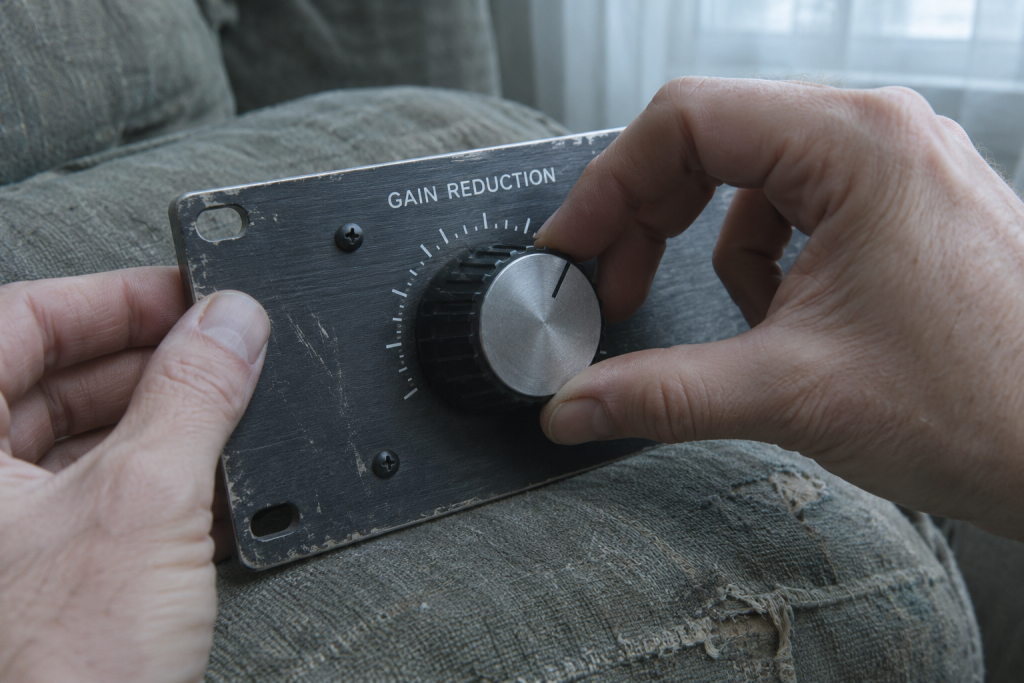
The tape was already shedding when I got it. A 7-inch reel labeled in ballpoint, “HILDA GARMAN / MIXES 2 / DO NOT PLAY ON QUARTER TRACK.” Whoever wrote that note knew exactly what would happen. Side one came off the heads with a sound like a cat being stepped on, and about ninety seconds of “Neon Boulevard” went with it. That’s how I learned what an LA-2A does on the way out, not just on the way in.
Two hours into that transfer I had a working theory that has since survived a lot of listening: for about ten years of Hilda’s output, one optical tube compressor was doing more to define the sound than any synth, any drum machine, or any edit she ever cut. Not because it was subtle. Because it was broken.
What the archive actually contains
For those new here: the Hilda Garman archive is roughly six crates of quarter-inch and cassette masters from the Hildadisco era, plus a shoebox of session notes and a dead Studer. Most of it is electro with a disco spine, the kind of thing that lives or dies on how the low end sits. The notes are cryptic. “More squash on the 2” means one thing. “The PA stopped working after this take” means another, and usually worse.
What the notes did tell me, consistently, was that a single LA-2A stayed patched across the bus for almost the entire run. It was rented, then borrowed permanently, then reportedly dropped down a flight of stairs in 1981. After the stairs, the notes change. Every reference to that compressor becomes “the soft one” or, once, memorably, “the liar.”
Why an LA-2A, of all things
The LA-2A is not a complicated box. You get a Compress/Limit switch for ratio, a Gain knob for makeup, and a Peak Reduction knob for how hard you’re hitting the threshold. That’s it. The ratio in Compress mode lands around 3:1, Limit pushes it toward infinity, and the knobs marked 0-100 are reference points, not dB. If you want a number, look at the VU meter instead.
That sparseness is the whole point. An engineer with a broken console and a frayed patchbay doesn’t need sixteen controls. She needs three. And the optical behavior itself is what leaves fingerprints. The T4 module reacts to program material, and different builds of the thing compress at measurably different speeds depending on which T4 is inside and how old it is. The late-sixties Silver is the fast one, the version people reach for on drums and anything transient-heavy. The mid-sixties Gray is medium-speed, a generalist. The very early LA-2 is the slow one, and it has a reputation for a mellow, slightly softened tone, partly because the luminescent panel inside the T4 has aged for fifty-odd years.
Hilda’s unit, according to one note, was “a silver one with a gray panel.” Which means the serial number is the only honest answer, and the serial number is gone. So I’ve been treating it as a Silver that compresses like a Gray, which is a very expensive way of saying “I don’t know.”
The sound the piano left behind
Here is what a program-dependent optical compressor does when it’s working. It slows down on the loud stuff, speeds up on the quiet stuff, and the result is that a bus full of disparate elements starts to move as one object. That’s glue, and it’s why people put an LA-2A across a mix bus rather than on individual channels.
Here is what it does when the release has drifted long because a capacitor is tired. Loud passages pull the whole mix down and then refuse to let go fast enough. The track breathes at the wrong tempo. On a disco edit, that’s death. On Hilda’s electro, it was the sound. Her low end didn’t pump, it sagged, and the sag gave the claps a place to land. I’ve spent months failing to recreate it with clean tools, because the clean tools are doing what the hardware was supposed to do.
Rebuilding it in the box, honestly
I tried the obvious route first: find the best LA-2A emulation and push it too hard. That gets you maybe 70% of the way there, and the missing 30% is all in the behavior of the compression itself.
What actually worked was serial compression. A fast FET-style compressor first, catching the peaks of the claps and the snare, then a slow optical one after it to smooth the whole thing into that sag. The order matters more than the settings. Fast then slow is the classic move: the first compressor eats transients and the second one breathes. Get the order wrong and you get mud plus a dull mix, which is the worst possible outcome for this material.
Three things I’d tell anyone chasing this:
- Do the automation before the compression. Ride the fader first, then compress. Hilda’s notes are full of “brought the verse down,” which means she was doing it by hand. Compression was the last 20%, not the first.
- A high-pass before the compressor. The archive mixes have a lot of low-end information the compressor should never see, or the whole track ducks every time the kick lands. Start around 40 Hz with a gentle slope and work up until it stops grabbing.
- Don’t chase the number. The meter on an LA-2A shows gain reduction, not a target. If you’re hitting -3 dB on peaks and it sounds right, it’s right. If it sounds like a pillow, back off the Peak Reduction.
The uncomfortable part
I need to be straight about something. Most of what makes the archive sound the way it does cannot be reproduced, because it was never designed. The stairs incident wasn’t a feature. The drift wasn’t a character setting. The softening in the early LA-2 models comes from aging components, not from an engineer’s taste.
That’s true of a lot of “vintage” character. Half of what we call warmth is decay. Which means the plugin emulations, good as several of them are, are chasing a moving target: they’re modeling the hardware at a specific point in its life, usually as manufactured, sometimes as restored. The emulation of an LA-2 that has spent fifty years with a glowing panel inside it is a different product from the emulation of a fresh one. Both are honest. Neither is Hilda’s.
So I stopped trying to match the sound and started trying to match the behavior. Sag on the bus. Slow release on the loud parts. A high-pass so the kick doesn’t punch holes in everything else. Then I A/B’d blind, and about four out of five times the listener picked the version with the slow optical compressor in series, even though they couldn’t say why.
What the two hours actually taught me
The transfer took longer than two hours. The first two were the education. I sat there with a cup of tea going cold and heard a compressor fail in real time, and then heard what “failure” sounded like when it became a finished record. The entire game happens in a single afternoon.
If you’re working with a similarly fragile archive, treat the playback as an audition, not just a transfer. Note every place the tape fights back: the dropouts, the dynamics that wobble, the way a passage refuses to sit still. Those are the only honest reference you’ll get for what the record was doing before it got pressed. Everything else is guesswork with a nice GUI.
The reel is back in the crate now, heads cleaned, nothing else lost. I’ll probably never find a Silver with a Gray panel. But I know what it sounds like, and that’s worth more than the plugin.