I keep a printed note taped to the bottom of my monitor: “slow attack, fast release, 2:1, tiny bit of needle movement.” That is all there is to it. Everything else on the bus is decoration.
The compressor those four numbers point to is an SSL Bus Compressor emulation, and after a few years of chasing the Hilda Garman tapes around my drives, it’s the one I reach for before anything else on old electro sessions. Not because it’s the most interesting box in the rack. Because it’s the plugin that stops asking for attention.
Why the old material asks for it
Electro from the Hildadisco era wasn’t mixed dense. It was sparse and it was loud and it leaned on the space between hits. You’ve got an 808 kick, a Linn-ish snare, a bassline doing most of the melodic work, and a bunch of delay tails filling whatever’s left. When you start stacking compressors on the individual tracks of that kind of session, the space collapses first. The tails get shorter, the transient stops breathing, and suddenly the record sounds like it was made last week by someone with too many plugins.
The bus comp handles this at the group level instead. One glue stage over the whole mix, doing very little, keeps the parts related without flattening any single one of them. That’s the entire argument. The SSL-style circuit carries a snappy, forward push, and the various emulations (SSL themselves, Waves, IK, Slate, Universal Audio, Cytomic, Native Instruments) are all in the business of contributing that cohesive mix feel. Whether any given one nails the hardware is a different conversation. For old electro, the character is the point, not the accuracy.
The settings, and why they’re boring on purpose
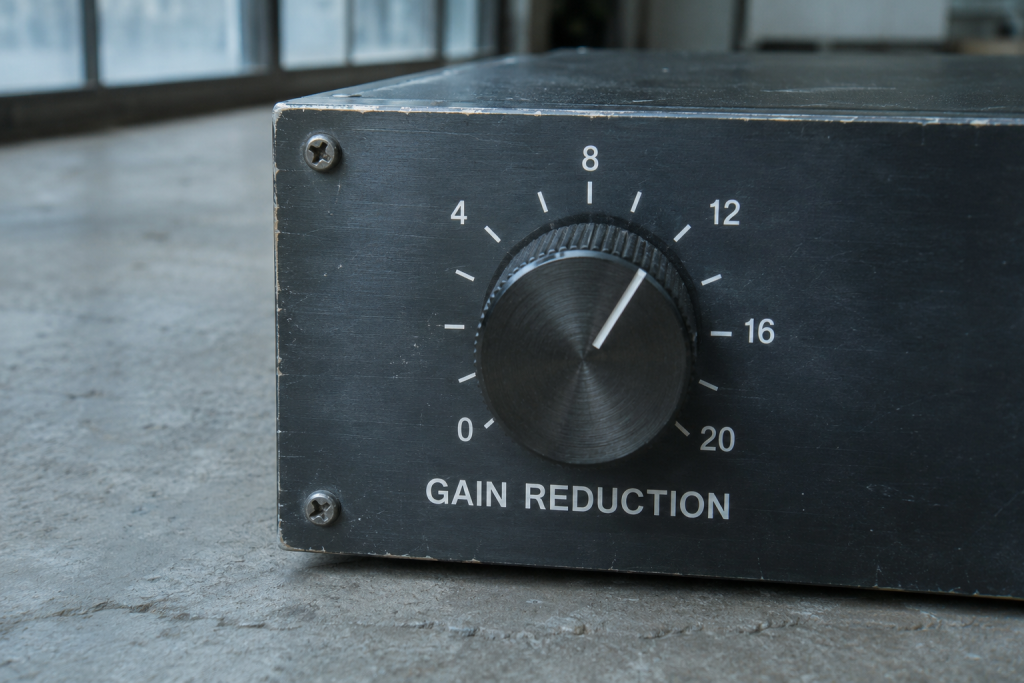
Begin gently: ease the attack in, let the release snap back, ratio at two to one, and barely touch the gain reduction. You want the needle to move, not to travel. If you’re looking at more than a couple of dB of movement on a mix that’s already balanced, you’re compressing because you don’t trust your fader moves, and that’s a different problem.
Slow attack lets the kick and snare through before the gain circuit reacts. That’s what keeps the drums feeling like they’re hitting you rather than being pushed back. Fast release clears the stage before the following transient hits, so you’re not pumping on a kick pattern that’s already got a shape. And 2:1 is a handshake, not a bear hug.
Where I actually deviate: on a busy disco edit with real disco drums, I’ll go a touch slower on the release than the default and let the kick drive the reduction a little. It makes the whole thing lean forward. On straight electro with a stiff programmed kick, I keep it as neutral as the box allows and let the saturation do the attitude instead.
The stuff it doesn’t do well, which is most of the marketing
It won’t fix a bad balance. It won’t make a thin bassline thick. It’s not a limiter and it’s not a maximizer and if you push it into heavy gain reduction it’ll smear the top end and make the delay tails sound like they’re underwater. I’ve tried. The result was a stereo mix that sounded like a cassette copy of itself.
It’s also not the right tool for surgical work. If the midrange is fighting, an SSL bus comp won’t separate it. Something like an M/S-capable compressor doing separate adjustments on the middle and sides is a better call for that job, and so is any of the multiband-style processors that let you attenuate a band dynamically instead of the whole signal. The bus comp is the wrong shape for that. It’s a glue stage, not a scalpel.
Where it sits in the chain
My old electro sessions almost always come out of the DAW’s summing bus, through the bus comp, and then into a limiter I’ve usually got turned off while I work. The order matters less than people think. What matters is that the comp goes before anything that adds color, so it’s reacting to the mix and not to the saturation. If I’m going to print a version with the Soundtoys Devil-Loc (that Level-Loc emulation) doing something ugly on a subgroup, the Devil-Loc goes early on the subgroup and the bus comp stays clean at the end. Let the destructive one be destructive in one place, not everywhere.
I keep the bus comp’s sidechain off on electro. Sidechaining the bass to the kick is a modern move, and the old records weren’t doing it. They were just arranged so the kick and bass didn’t collide. That’s still better.
Emulations, briefly, and what I’d actually recommend
I’ve used more than one and they’re not interchangeable, but for this specific job the differences are smaller than the price tags suggest. The SSL-branded one is the reference and it’s where I’d start if you’re buying once. The UAD version is solid. Cytomic’s is the one the people who care about component modeling argue about. Waves is the one you’ll find in templates you inherit from other people, which is its own kind of recommendation. If you’re on a budget and already have a DAW with a decent channel strip, the stock bus comp in that strip covers most of the ground to the “glue” and you can spend the money on a better interface instead.
One caveat: the different revisions of the 1176 (Bluestripe, Rev E, the Anniversary Edition) get talked about in the same breath as bus comps sometimes. They’re not the same thing. The 1176 is aggressive and characterful and great on drum rooms and vocals that need attitude. The SSL bus is a glue box. Do not put the 1176 “all buttons in” over your whole electro mix unless you’re deliberately going for a sound that’s already ruined, which, honestly, sometimes I am.
The unglamorous part
None of this survives a bad driver. I’ve spent more evenings than I’d like to admit chasing buffer sizes and ASIO panel weirdness because a session that was working fine yesterday started clicking. The bus comp doesn’t cause that. But it will absolutely expose it, because glue compression makes any instability in the low end more audible, and then you’re troubleshooting a plugin when the problem is upstream.
Before you blame the compressor, check the interface. Check the buffer. Check whether your last plugin update quietly changed something. I’ve got a separate piece’s worth of notes on latency creep on that old interface and none of it was ever the bus comp’s fault.
What the bus comp does, when everything else is stable, is make four sparse elements sound like they’re in the same room. That’s it. The value lies entirely there. Slow attack, fast release, 2:1, needle barely moving. I reach for it on every electro session because it never asks me to think about it, and on a session full of old tape hiss and broken 808s, that’s the highest compliment I can pay a plugin.